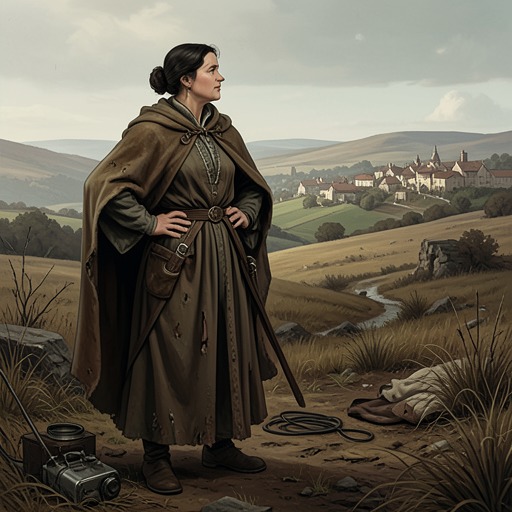
Cowdray House
The King's CurseCowdray House, in Sussex, becomes both a place of confinement and a refuge for prayer in Margaret Pole’s final years. In the winter of 1538, she is brought there as a prisoner while her property is seized and investigators press her for evidence against her family. The house’s tower rooms make royal custody part of daily life; by spring 1539, its chapel has become the setting for an all-day vigil for the relatives caught in the same political danger.
Setting and Arrival
Cowdray is William Fitzwilliam’s new house, and the account emphasizes the pride with which he occupies it. Margaret and her companions reach it after two difficult days on muddy, flooded roads, losing their way repeatedly on the ride south to Midhurst. The journey also reveals what has changed in the surrounding country: where a monastery once offered lodging and help with directions, a great abbey church now stands dark, its stained glass smashed for lead and its roof stripped of slates. At Petersfield, a poor inn and hungry beggars bear witness to the loss of the abbey kitchens, hospital, and charities. Cowdray thus receives Margaret at the end of a journey through a landscape altered by the closing of religious houses.
The approach to the house is described in quieter, more beautiful terms. Margaret rides across broad fields beneath leafless trees as the sun sinks behind the forested folds of the Rother valley. The frosty evening and pale-pink sky give the arrival a moment of stillness, but her thoughts remain fixed on what she has lost: her own fields, the possibility of returning home, and the hope that her sons will come back to her. The prospect of a better tomorrow is something she has to trust in, not something the scene promises.
At the entrance, the welcome is carefully staged. Mabel Clifford, Fitzwilliam’s wife, waits with her ladies in her best gown and an English hood, but her face shows her bad temper. Margaret offers only the slightest curtsey and watches Mabel answer it reluctantly. Mabel has prepared the tower rooms, yet the exchange leaves uncertain how she is expected to behave toward a woman who has been delivered into her household’s keeping. Margaret attributes Mabel’s anger to family history: Mabel’s father spent much of his life in hiding as a traitor to the Plantagenets. The house is therefore not politically neutral ground, even before the questioning begins.
The Tower Rooms and Interrogation
Margaret is taken to the tower rooms, arranged one above another around a circular stair. She climbs slowly, aching, but is not allowed to go alone. Even the handrail becomes a small measure of constraint: she will not use it to pull herself upward while someone is watching. Fitzwilliam accompanies her and, as she longs to rest by a fire and eat, questions her again about Reginald Pole and whether Geoffrey Pole meant to escape to him. The architecture organizes the scene as a controlled ascent, with a guard and interrogation accompanying Margaret into her assigned rooms.
The scrutiny continues the following morning, before breakfast, while Margaret is saying her prayers. Fitzwilliam arrives with papers. After she left Warblington Castle, her rooms there had been searched and turned upside down. The investigators found a letter she had been writing to her son Montague, but its message was simply that he should remain loyal to the king and trust in God. They had also questioned her kitchen clerk, Thomas Standish, and treated his fear that Geoffrey might slip away as incriminating. Margaret recalls the circumstance that gave rise to the remark: Geoffrey had injured himself in the Tower, and the family feared he might die. She corrects Fitzwilliam’s account and rejects his accusation that she changes her words. At Cowdray, ordinary family correspondence, recollection, and concern for an injured son are all made vulnerable to official reinterpretation.
The Chapel and the Family Vigil
By spring 1539, Cowdray’s chapel provides a different kind of enclosed space. Margaret spends the day there, from dawn until dusk, facing the de Bohun tomb. The quiet chapel does not release her from the consequences of confinement; it gives her a place to name those consequences in prayer. She prays for Montague and for his cousins Edward and Henry, who have been taken to Tower Hill and executed. Her remembrance connects their deaths to an earlier family loss: their uncle had also died there, an innocent man in her account.
Her prayers extend beyond the dead. She thinks of Henry Courtenay’s son, Edward, who may have watched his father’s final walk from his window, across the frosty grass and out through the gate toward Tower Hill and the block. She also prays for Montague’s children: Harry, who is safe with his mother at Bockmer, and Katherine and Winifred, who have joined Margaret at Cowdray for the vigil. Most urgently, she prays for Geoffrey, whom she believes will wish himself dead that night because his actions have helped bring the family to this tragedy. The house holds both the living and the memory of the executed within Margaret’s vigil.
Significance
Cowdray’s role changes with the form of Margaret’s confinement. Its tower rooms are a place where she is watched, questioned, and confronted with evidence gathered from a searched home and a pressured servant. The chapel, by contrast, allows her to keep the family’s losses in view and to distinguish her own understanding of events from the authorities’ accusations. Neither space offers freedom: one makes surveillance physical, while the other concentrates grief and fear into sustained prayer.
The house also stands at the intersection of private property and royal power. Margaret is told that she will be imprisoned at Cowdray and that her estate and goods are being seized; the residence she enters is identified as Fitzwilliam’s new property. Her journey past a stripped abbey and her arrival at a household shaped by Plantagenet history place her personal ordeal amid wider changes in landholding and religious life. Cowdray is consequently more than a backdrop: it gives spatial form to the narrowing of Margaret’s world, from her own estate to guarded rooms, and then to the chapel where she can only pray for those she cannot protect.